Monday, 25 September 2017

The Habits Guide: How to Build Good Habits and Break Bad Ones

Change your life the easy way with this scientifically–backed resource. The full guide is packed with 45 pages of information about the science of how to stick to good habits and break bad habits.
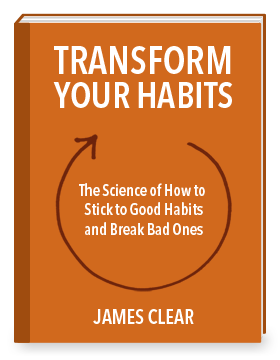
Transform Your Habits by James Clear
The guide is filled with proven research on how to make changes, overcome obstacles, and reach your goals. You'll get more than 2 years of research from top behavioral experts distilled into an easy-to-understand guide. For instant access, just enter your email address and click “Get Updates!”
You'll get immediate access to the guide, plus you'll receive new articles every Monday and Thursday about building good habits, breaking bad ones, and living healthy.

What Are Habits?

Let's define habits. Habits are the small decisions you make and actions you perform every day. According to researchers at Duke University, habits account for about 40 percent of our behaviors on any given day. 
Your life today is essentially the sum of your habits. How in shape or out of shape you are? A result of your habits. How happy or unhappy you are? A result of your habits. How successful or unsuccessful you are? A result of your habits.
What you repeatedly do (i.e. what you spend time thinking about and doing each day) ultimately forms the person you are, the things you believe, and the personality that you portray. Everything I write about – from procrastinationand productivity to strength and nutrition – starts with better habits. When you learn to transform your habits, you can transform your life.
This page includes recommended resources on forming better habits and breaking bad ones in any area of life, but if you'd like to explore information on specific types of habits, check out these articles:

3 Ways to Form Better Habits

  1. How to Build a New Habit: This is Your Strategy Guide: Read this guide right now to learn 5 easy, powerful strategies for changing habits.
  2. The 3 R’s of Habit Change: How To Start New Habits That Actually Stick:  Every habit you have — good or bad — follows the same 3–step pattern: Reminder (the trigger that initiates the behavior), routine (the behavior itself; the action you take), and reward (the benefit you gain from doing the behavior). This helpful framework can make it easier to stick to new habits so that you can improve your health, your work, and your life in general.
  3. Identity-Based Habits: How to Actually Stick to Your Goals This Year: Most of the time we set our goals in the wrong way. Read this article to learn how identity-based habits can help you achieve your goals more easily.

3 Ways to Break Bad Habits

  1. How to Break a Bad Habit and Replace It With a Good One: Want to learn how to break a bad habit? Read this article to discover the science of breaking bad habits and practical suggestions for making it happen.
  2. How Vietnam War Veterans Broke Their Heroin Addictions: By simply removing yourself from an environment that triggers all of your old habits, you can make it easier to break bad habits and build new ones.
  3. How to Declutter Your Mind and Unleash Your Willpower by Using “Bright-Line” Rules:  A bright-line rule refers to a clearly defined rule or standard. It is a rule with clear interpretation and very little wiggle room. It establishes a bright line for what the rule is saying and what it is not saying. Most of us could benefit from setting brighter lines in our personal and professional lives.

How to Make a Habit Stick

How to Build Habits That Last and Design Life as You Want It

Want to learn everything you need to build better habits and break bad ones? I recommend the Habits Academy.
The Habits Academy is the world's most comprehensive course on habits and the science of human behavior. More than 5,000 students have taken the course. Over 40 video lessons are available to Habits Academy students.

 Best Habits Books

Want more great books on psychology and self-help? Browse his full list of the best psychology books and best self-help books.

Adele - Hello


This is a beautifully haunting song. It was played at an Aunt's funeral and manages to bring tears to my eyes every time. Any songs that do that for you?

Friday, 22 September 2017

What If You Stopped Sleeping?


I have just had 3 weeks of disturbed sleeping and short nights due to some training I was on - it ended up bringing on a recurring viral infection similar to flu that is my body's way of saying ENOUGH!! How does it affect you?

Thursday, 21 September 2017

The Power of Writing to Heal and Improve

Words have power. Writers, intellectuals and influencers have known about the power of ideas for centuries. The written word has enabled people to record events, pass down traditions and has aided us in developing complex reasoning. Writing, in fact, helps us to discover what we already know; it’s the process of streamlining our own ideas, a transformation that starts in our minds and is channeled through pen to paper. Transformation is the key word here, because words have the ability to change our way of thinking and empower us.
This is exactly what Helen Keller found when she discovered the power of words, before which she was feral. “For nearly six years I had no concepts whatever of nature or mind or death or God. I literally thought with my body. Without a single exception, my memories of that time are tactual… I know I was impelled like an animal to seek food and warmth… There is not one spark of emotion and rational thought in these distinct yet corporal memories. I was like an unconscious clod of earth. Then, suddenly, I knew not how or where or when, my brain felt the impact of another mind, and I awoke to language, to the knowledge of love, to the usual concepts of nature, of good and evil! I was actually lifted from nothingness to human life.”

Why write in the first place?

Writing, or more accurately expressive writing, has been used as a form of therapy for decades. It uses the written word to process and refine various emotions. This can manifest itself in a few different forms. For example, James W. Pennebaker’s writing therapy instructed participants to write about a past trauma and their feelings and thoughts that surrounded it. This enabled people to better deal with the trauma they were writing about. And, while writing about the actual event was painful, they found significant resolve, closure and meaning in the experience after having written about it consistently.

Blogging as a means of therapy and self-improvement

Writing, therefore, has a direct link to one’s happiness and the power to improve your emotional as well as spiritual well-being. Traditionally this has taken the form of journaling and writing by hand, but since the explosion of computers and the internet, blogging has become one of the popular forms of expression and release. The ease with which one can create a successful bloghas no doubt contributed to this and led many people to start their own blogs. And while some might scoff at the idea that blogging can have the same benefits that traditional journals or other forms of writing have, there’s hard evidence that says otherwise.
Alice Flaherty, a neuroscientist at Harvard University and Massachusetts General Hospital, studies conditions such as hypergraphia – a seemingly uncontrollable urge to write constantly – and writer’s block, believes that blogging might trigger a release of dopamine in the brain, similar to stimulants and rewards generated by activities like running, listening to music and playing video games. Nancy Morgan, an author of the Oncologist study advocates that blogging offers similar benefits to expressive writing, and has found evidence of this in people coping with cancer and other serious medical conditions. Having a platform to express yourself, as well as the added ability to connect with other individuals experiencing similar circumstances, is not only therapeutic but allows for an added sense of community and empathy.

Writing to reduce stress

Writing is also a great way to destress. Again, this can take the form of a journal or a blog, but there are a number of reasons why writing can help reduce stress. One of the main problems with thoughts and worries are that they are generally unformed and seem much larger when they’re in our minds. Writing them down helps to shrink them to a point where they are life-sized and manageable. It facilitates problem-solving by allowing you to state very clearly what your problems are, and once seen on paper allows you to confront it in a much more tangible way.

Writing to empower

And, of course, writing can empower you. Whether it’s reducing stress, changing your state of happiness or increasing your knowledge and self-awareness, writing ultimately changes your mind, and that in turn changes your life. If nothing else, writing will remind you that it’s you, and no one else, who is author of your story, the master of your fate and the captain of your soul.
Jumpstart your personal transformation and get on track to build your best life with Goalcast’s new inspirational ebook, Explore Your Potential: Start the Journey to Your Dream Life.
Transformation doesn’t just happen. It takes a plan and a support system. This how-to guide is full of the top wisdom, tips, exercises, and success stories to inspire an old dream or create a new one.
Check out a teaser of what’s inside.


Monday, 18 September 2017

An Introduction to Surrogate Tapping - Jessica Ortner


I am a big fan of tapping - and of the Ortners whose website has some free stuff on!

I liked this as sometimes we can feel helpless when some is suffering, and in this way, we can still do something.

Be careful though, as you cannot help/take on others issues, because it is their life lesson - not yours, we can however, have them in our hearts wishing them well.

Let me know how you get on!

Sunday, 17 September 2017

Do You have what it Takes to be a successful Leader?

Source


Discover Your Potential To Elevate Others To Greatness With This Quick & Easy Quiz
  • Discover how to contribute your fullest abilities to the world
  • Realize your true potential for leadership and innovation 
  • Identify your talents and abilities so you can strengthen them to higher levels 


Figure out the best ways to add value to your family, community, and the world
Take this groundbreaking FREE quiz and uncover your inner leader now!


Great leaders make it a habit to respond in ways that generate the outcomes they want, even during extremely tough experiences or events seemingly beyond their control.


- Jack Canfield


Take 60 Seconds to Determine Your Future

What Does Success Look Like?

Working with clients who want something more in life, my question is all about what that might look like. I thought I would share the parabl...